
The idea of personal and hereditary symbols is ancient, found across Egypt, Assyria and Greece, long before what we now call Heraldry existed. Its emergence as a formal science in England dates to around the middle of the 12th century, though nobody knows precisely who devised its rules or first regulated its use. By the 13th century, it had become a governed discipline with well-defined conventions.
Its original purpose was entirely practical. In battle, fully armoured knights were indistinguishable from one another, and a leader unrecognisable to his own men was a liability. Heraldic devices on shields and banners solved this problem. In peacetime, at a time when most people could neither read nor write, a seal bearing a coat of Arms served as a binding personal signature on legal documents.
In the earliest days, Arms were assumed freely, without any formal grant, established simply by long use and common reputation. The great dispute of 1385 between Sir Richard Scrope and Sir Robert Grosvenor over the right to bear the Arms Azure a bend Or highlights this well. Hundreds of noblemen and knights gave evidence, and none could say when or where the Arms had originated; they had simply always been borne. It was a custom that served to govern Heraldry in its infancy.
"They had simply always been borne."
It was not long before the Crown began to assert control over the bearing of Arms as a royal prerogative. Throughout the Middle Ages, the Sovereign made grants of Arms personally by charter, a right eventually delegated to the Kings of Arms. From the time of Henry VIII, this right has been conferred by Letters Patent under the Great Seal of the Realm. The College of Arms, incorporated in 1483, continues to serve as the depository of records of Arms and pedigrees. The granting authority rests with the Kings of Arms, acting under the prerogative of the Sovereign and the general control of the Earl Marshal.
The colours of Heraldry are few: gules (red), azure (blue), sable (black), vert (green), and purpure (purple), alongside the metals or (gold) and argent (silver). The fundamental rule that colour must not be placed upon colour, nor metal upon metal, arose directly from the need for instant recognition at a distance. The language of Heraldry was adopted when Norman French was in general use, and though it may strike us as obscure, it is in fact precise and economical: a single heraldic term often replaces entire lengthy and descriptive sentences.
When Arms were inherited or acquired through marriage or descent from more than one family, it became customary to display those Arms together by dividing the shield into quarters. This practice, which developed around the end of the 13th century, gives the quartered shields familiar from great houses their distinctive appearance. Within a family, different branches are distinguished by marks of cadency, small additions to the Arms identifying a younger son or a collateral line.
Heraldry remains a living and practical science. In His Majesty's Armed Forces, it is ubiquitous: every ship in the Royal Navy, every squadron in the Royal Air Force, and every regiment in the British Army has its identifying heraldic badge or colours, all grounded in the same principles laid down in the 13th century.
In civic and institutional life, its presence is equally strong. The Arms of the great City of London livery companies date from the 15th century, and the corporations of Merchant Adventurers were among the earliest to bear them. Banks, insurance companies, universities, colleges, and associations formed for the promotion of learning are all properly entitled to bear Arms, and many do. Where once a Royal Charter was the only means by which a corporation could be formally created, the Companies Acts have since provided a simpler path to incorporation, but the bearing of Arms remains a mark of institutional dignity that no Act of Parliament has replaced.
For families, Arms are a symbol of identity and individual achievement. Coats of Arms represent a distinctive mark of a family and its history, carrying with it an obligation to the traditions it embodies.
The ten King's Beasts are the heraldic supporters and badges drawn from the dynastic history of the Crown. Each bears a shield whose Arms narrate a chapter of that history. Select a Beast to learn more.
With thanks to the Royal Mint Museum for permission to use their artistic renderings of the royal beasts.
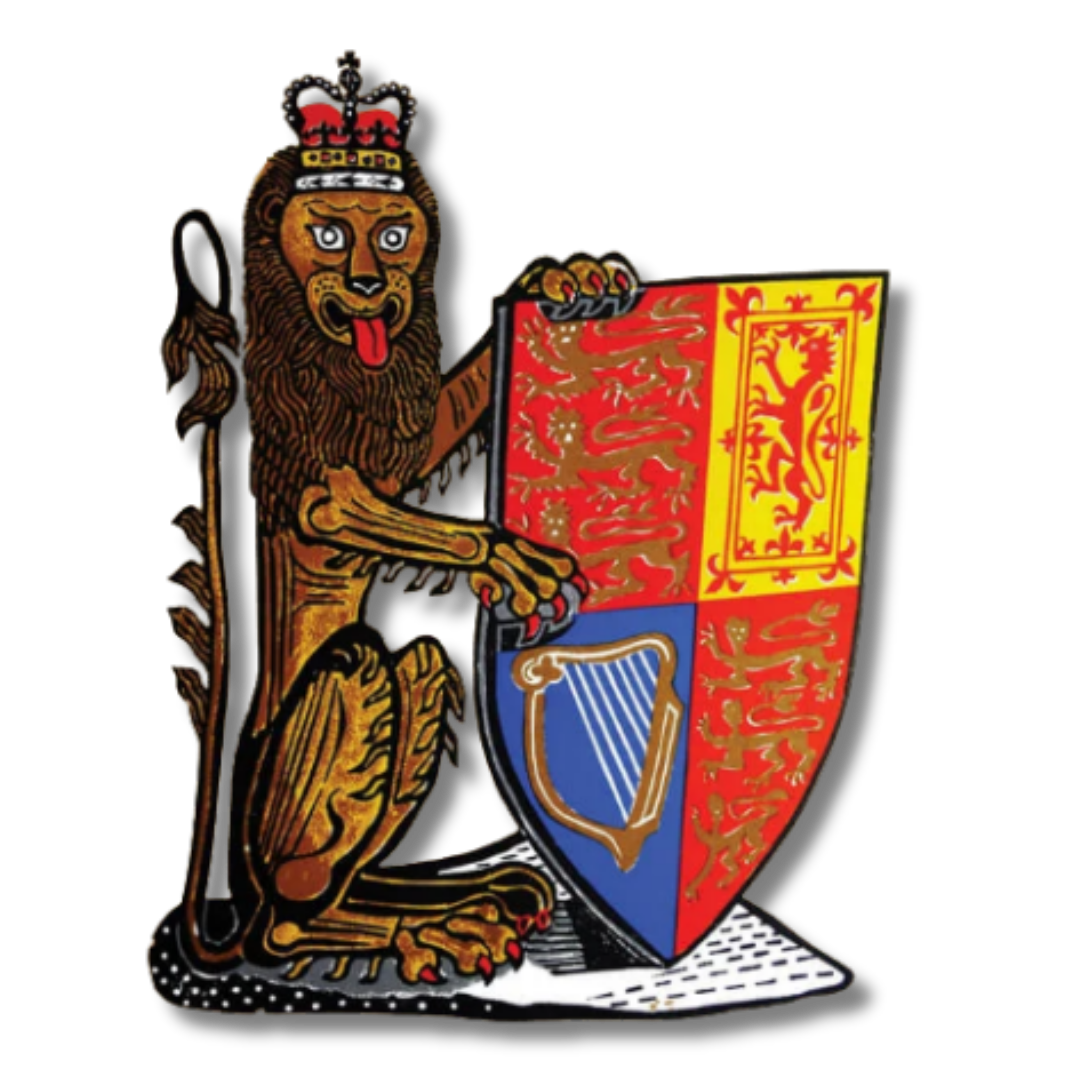
The crowned golden lion has supported the Royal Arms since the reign of Edward IV. It bears a shield displaying the Arms of the United Kingdom as they have stood since the accession of Queen Victoria in 1837. The first and last quarters show the three golden lions of the House of Plantagenet, first borne by Richard I and carried by the Crown ever since. The second quarter bears the lion and tressure of Scotland, and the third the Harp of Ireland.
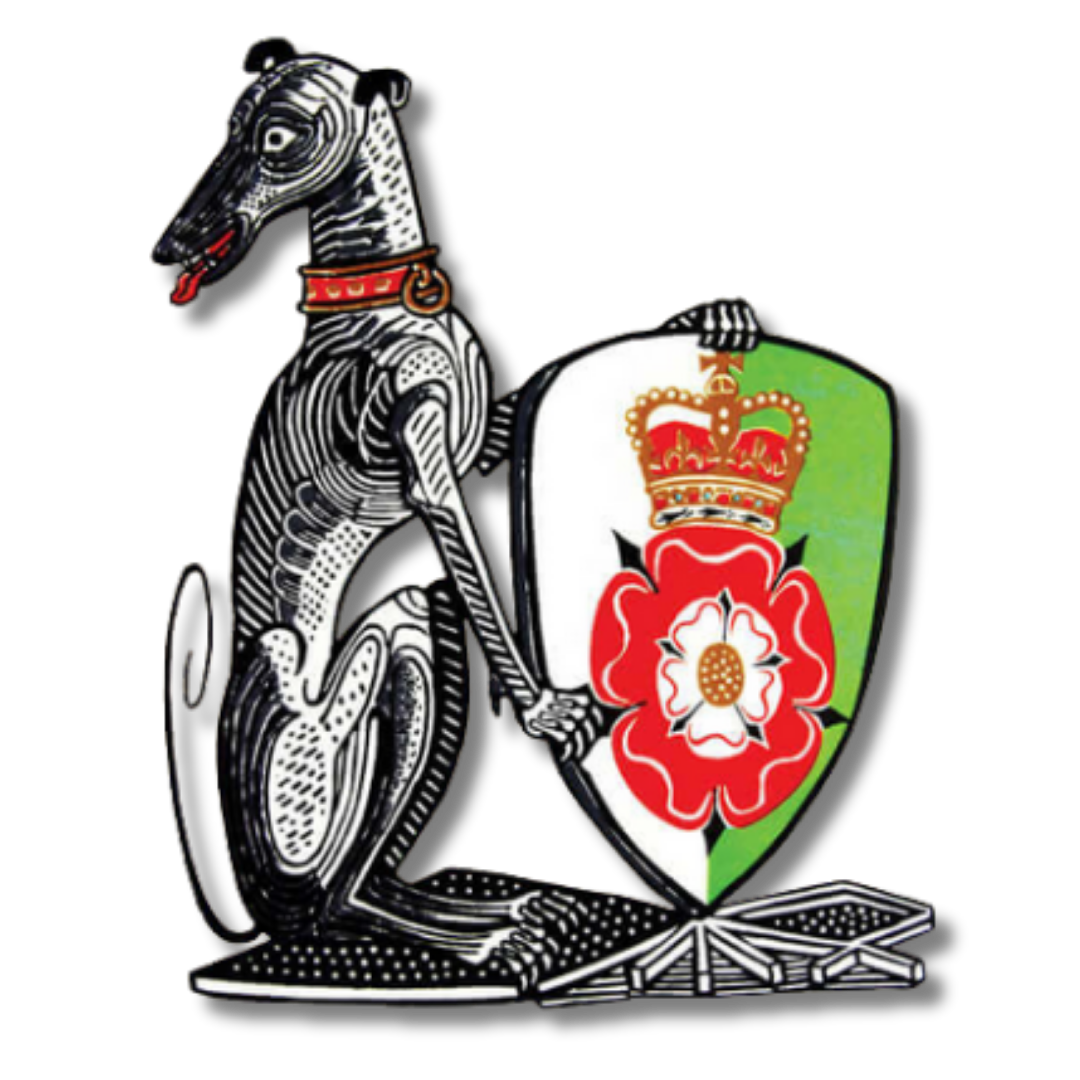
The White Greyhound has its origins as a personal badge of John of Gaunt, third son of Edward III and 1st Duke of Lancaster. It passed through the Lancaster line to Henry IV and was taken up with particular enthusiasm by Henry VII, the first Tudor king. The shield it supports bears the Tudor rose, whose double form commemorates the marriage in 1486 of Henry VII to Elizabeth of York, ending a generation of civil conflict and uniting the rival emblems of the two great cadet branches of the House of Plantagenet into one.
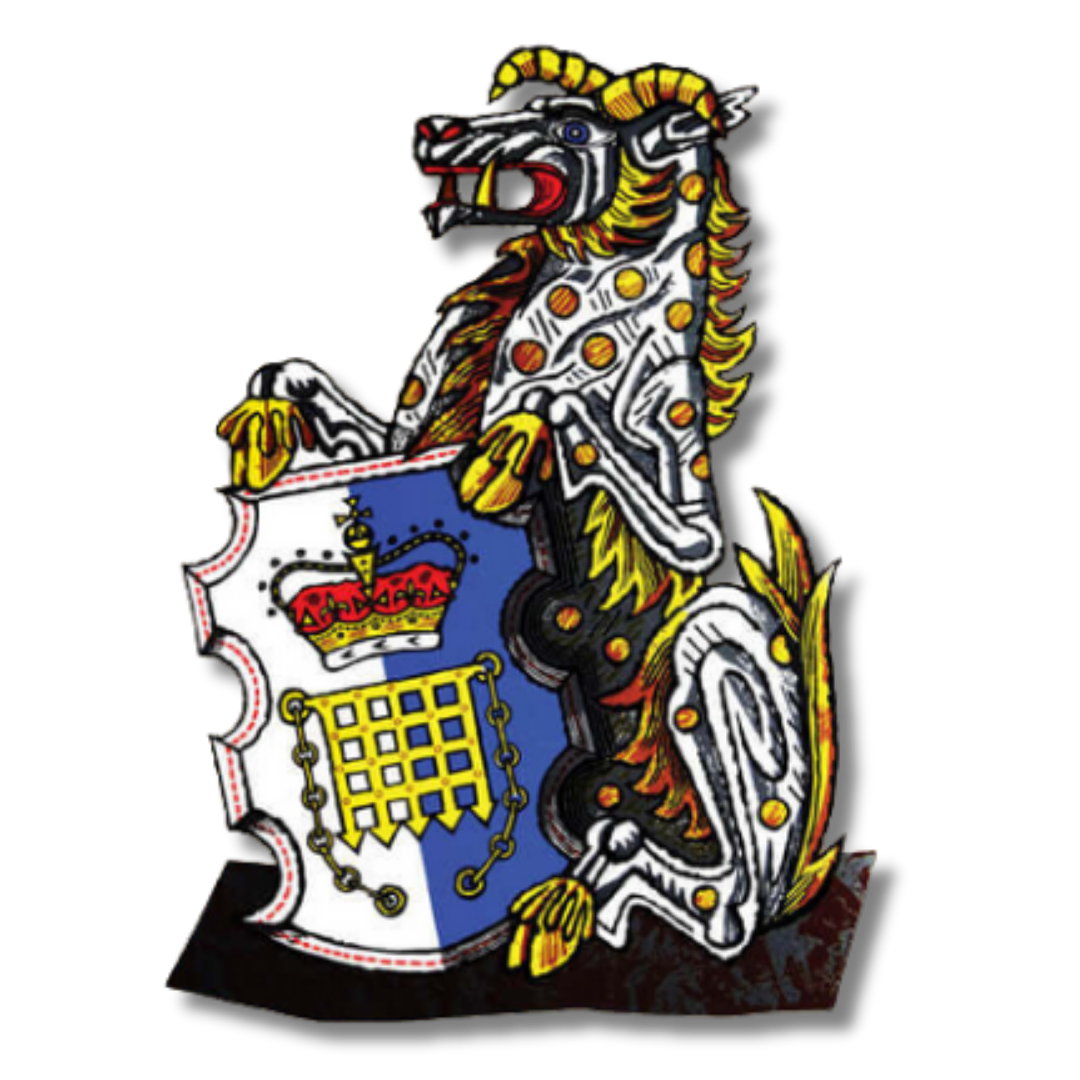
The Yale is a mythical creature, white, spotted with gold, and possessed of the unusual ability to swivel each of its horns independently. As a heraldic beast, it passed to The King through Henry VII, who inherited it from his mother, Lady Margaret Beaufort, one of the most formidable figures of the 15th century and the driving force behind the Tudor claim to the throne. The shield the Yale supports bears a portcullis surmounted by a royal crown — a Beaufort badge adopted by Henry VII in both its crowned and uncrowned forms.
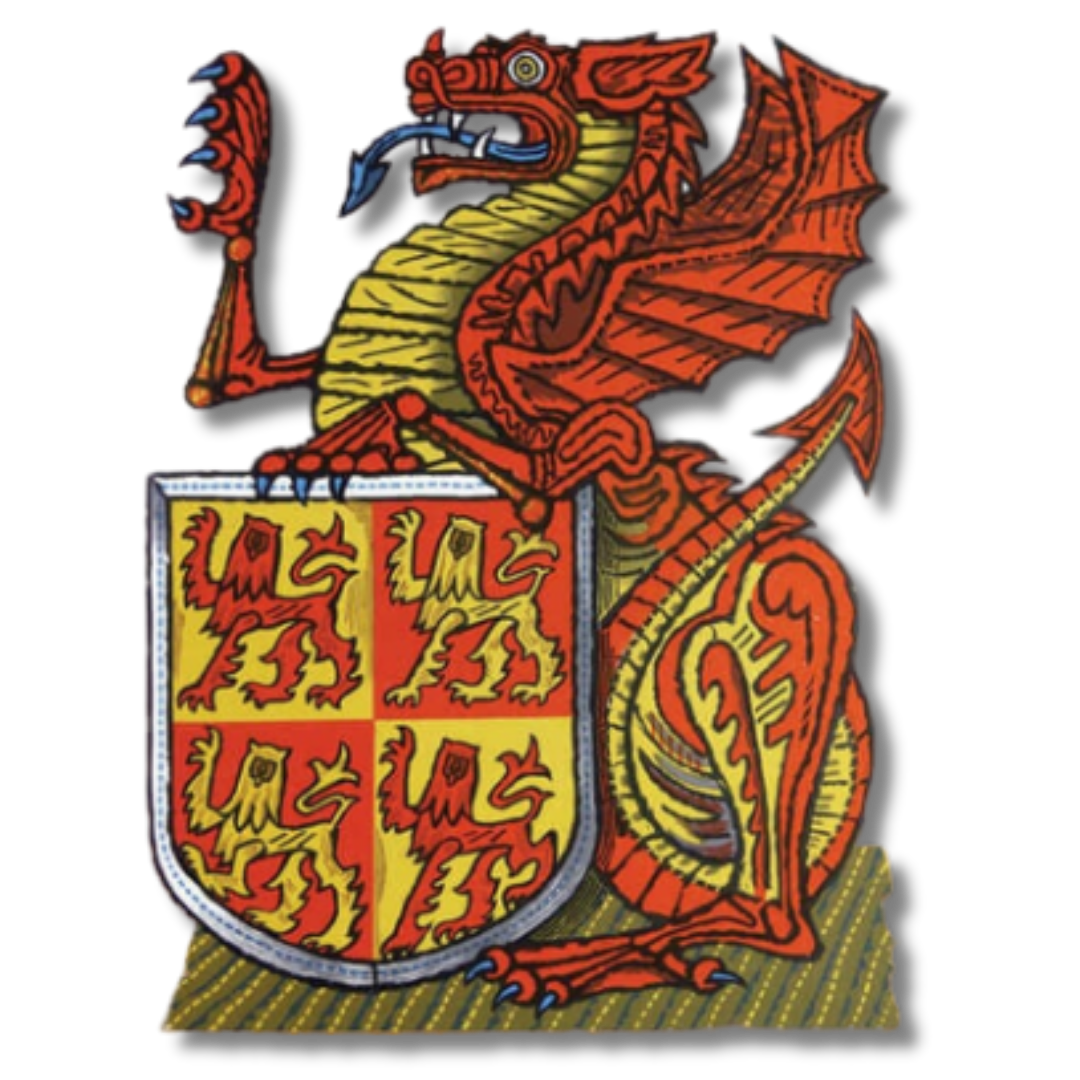
The Red Dragon is amongst the most ancient of Welsh symbols, and was used as a personal badge by Owen Tudor, grandfather of Henry VII. Henry himself claimed descent from Cadwaladr, the last of the line of Maelgwn, a lineage with its own deep association with the dragon. The shield the dragon bears is quartered with lions, the coat of arms of Llywelyn ap Gruffudd, the last native Prince of Wales, whose defeat by Edward I in 1282 marked the end of independent Welsh rule. That Henry VII chose to display these Arms speaks to his deliberate cultivation of his Welsh heritage as a source of dynastic legitimacy.
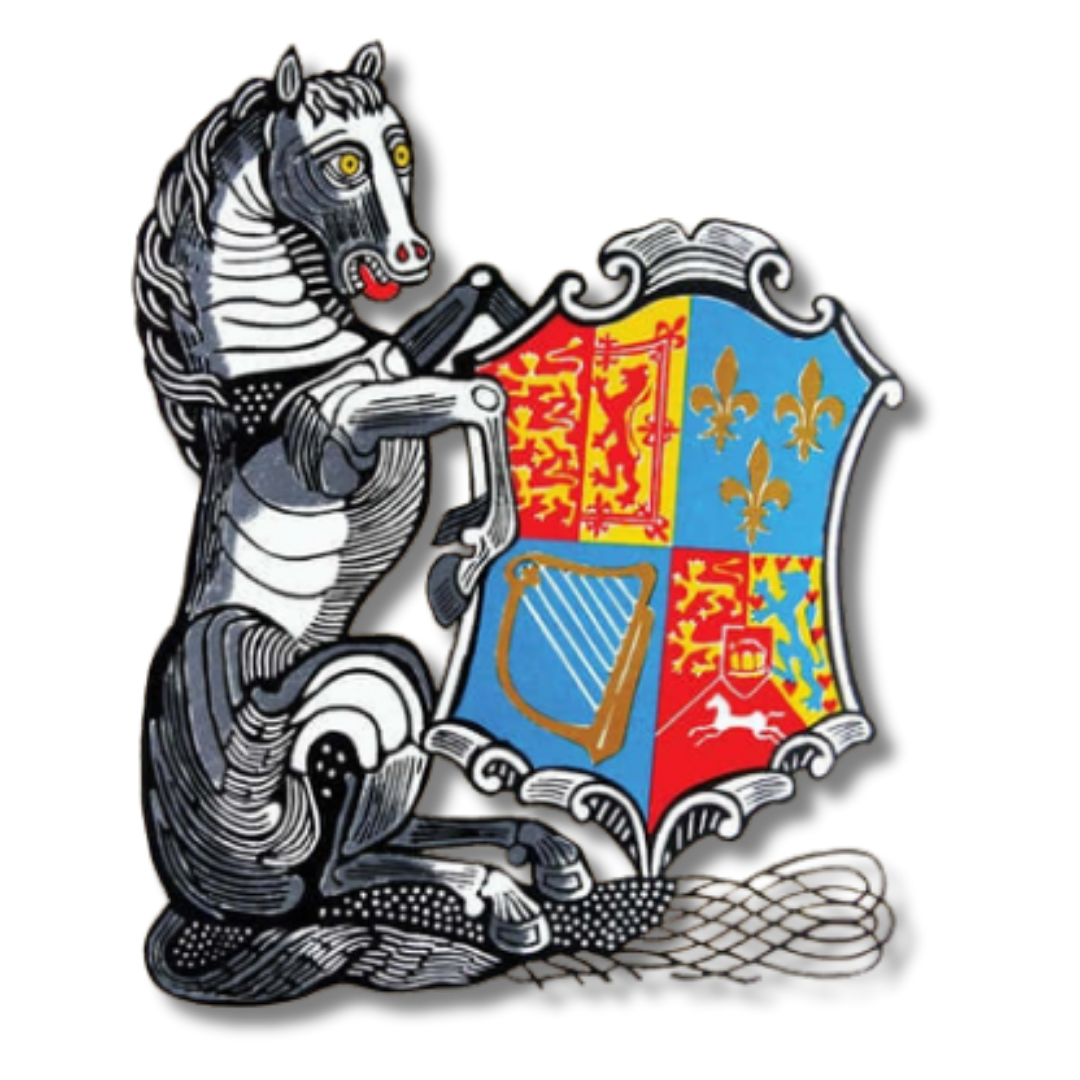
The White Horse of Hanover entered the Royal Arms in 1714, when the death of Queen Anne without surviving heirs brought the crown of Great Britain to George, Elector of Hanover, who became George I. His claim came through his mother Sophia, granddaughter of James I, the Protestant line having been secured by the Act of Settlement of 1701. The shield the horse supports reflects the accumulated heraldic history of the Crown at that moment, including for the first and only time the Arms of Hanover — a dynasty that would reign for over a century before the accession of Queen Victoria brought the Hanoverian line to a close.
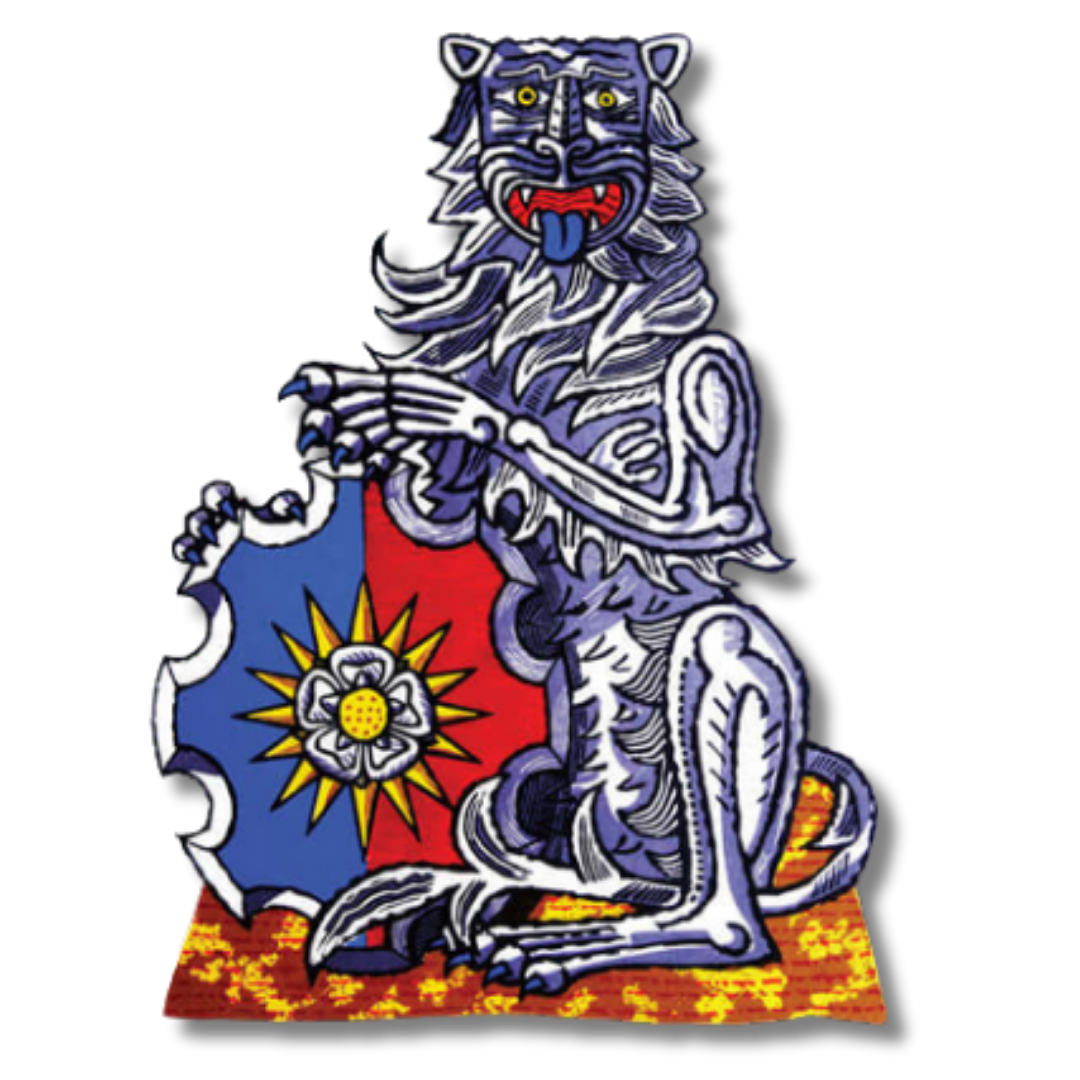
The White Lion of Mortimer descends to the King through Edward IV, from Anne de Mortimer, and unlike the Lion of England it is uncrowned — a distinction that reflects its status as a dynastic rather than a sovereign symbol. The shield it bears displays the white rose en soleil, combining two distinct badges: the white rose of York and the golden sun, both of which appear separately on the Great Seals of Edward IV and Richard III. George VI used it during his time as Duke of York, a remarkable continuity of heraldic tradition across five centuries.
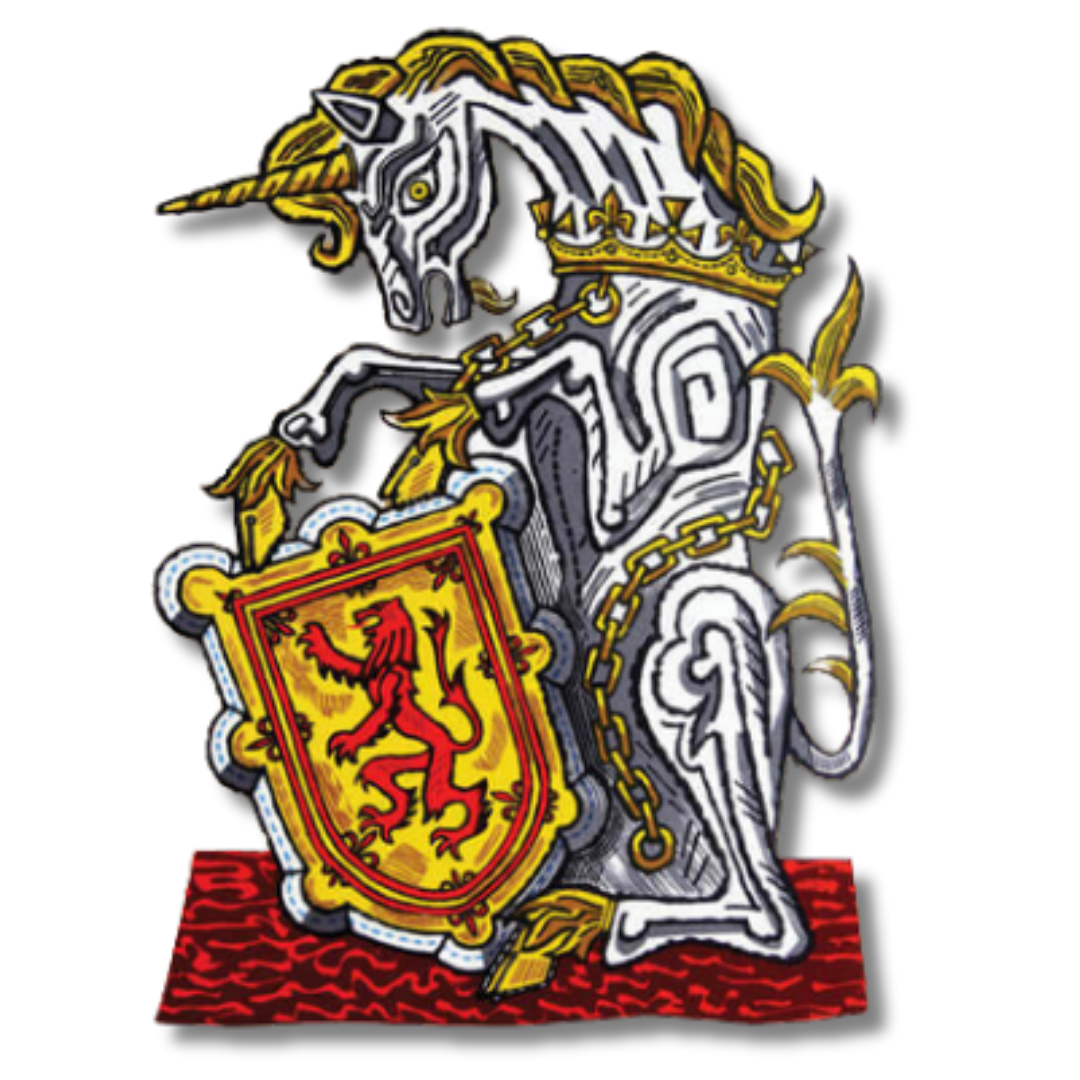
The Unicorn has been associated with Scottish royalty since the end of the 15th century, when two unicorns were adopted as the supporters of the Scottish Royal Arms. When James VI of Scotland inherited the English crown in 1603, becoming James I of England, he brought one of his unicorns with him, placing it alongside the crowned lion of England to create the pairing that has supported the Royal Arms ever since. The shield the unicorn bears displays the Royal Arms of Scotland: a lion rampant enclosed within a double tressure flory-counter-flory, one of the most elegant and distinctive compositions in European Heraldry.
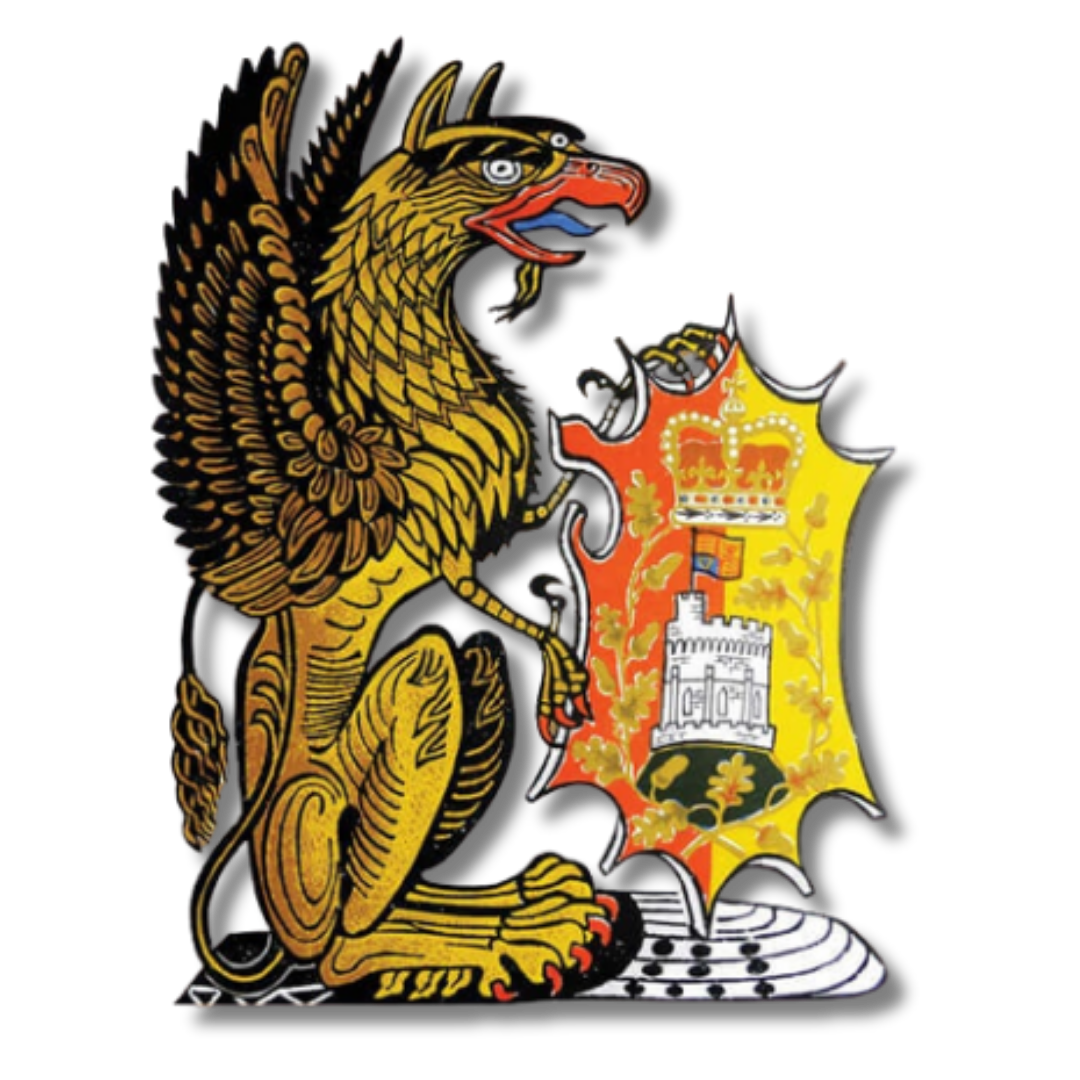
The Griffin is amongst the most ancient of mythical beasts, long associated in heraldic tradition with courage, strength, vigilance and guardianship. Its association with Edward III was a personal one; he engraved it upon his private seal, giving it an intimacy that sets it apart from the more formal dynastic beasts. The shield it bears displays the Round Tower of Windsor Castle, where Edward III was born, with the Royal Standard flying from the turret and two branches of oak framing the composition beneath the royal crown.
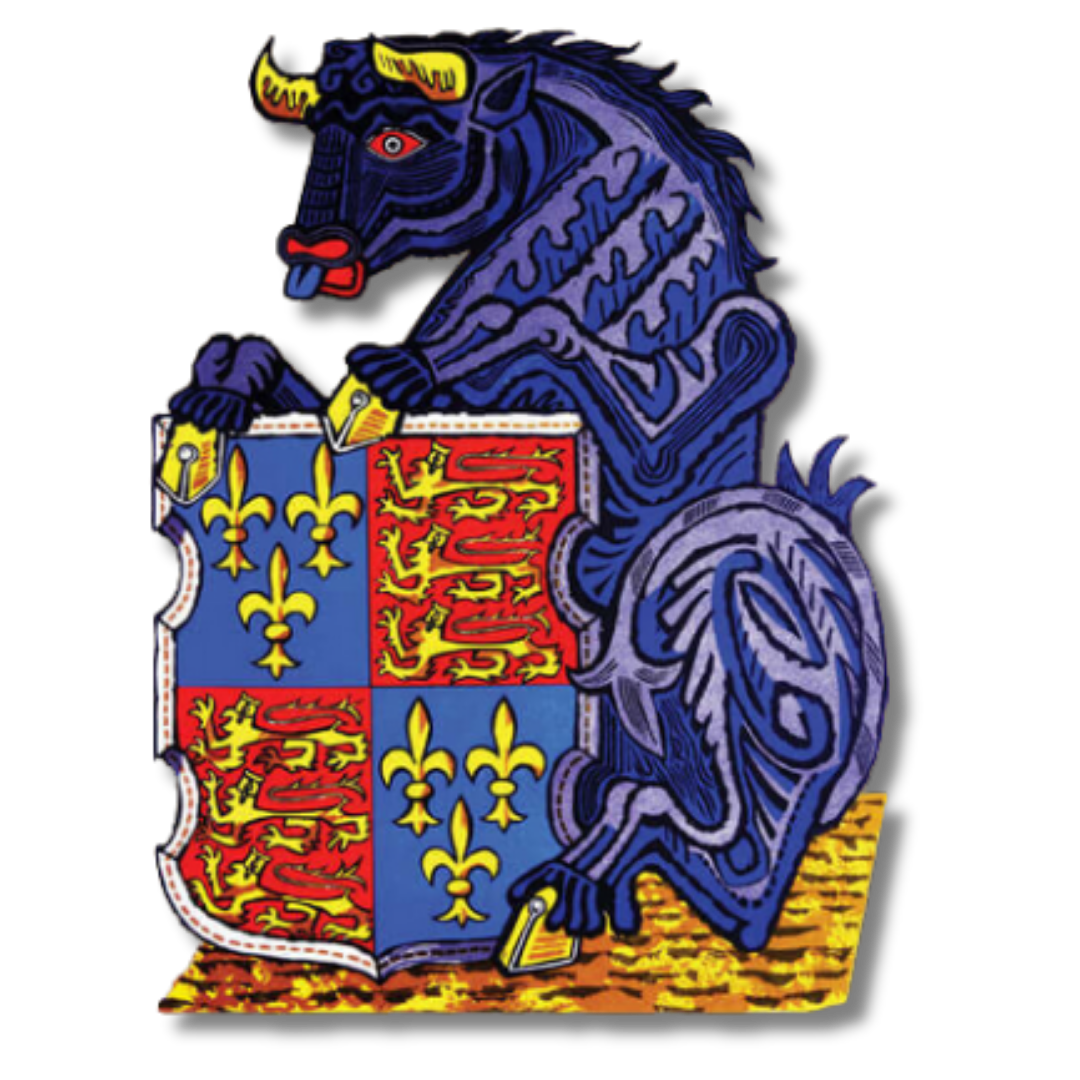
The Black Bull of Clarence descends to the King through Edward IV, and carries with it the heraldic weight of one of the most turbulent periods in English history. The shield it bears displays the Royal Arms as they stood throughout the reigns of Edward IV and Richard III, and as they were borne by every sovereign of the Houses of Lancaster and Tudor.
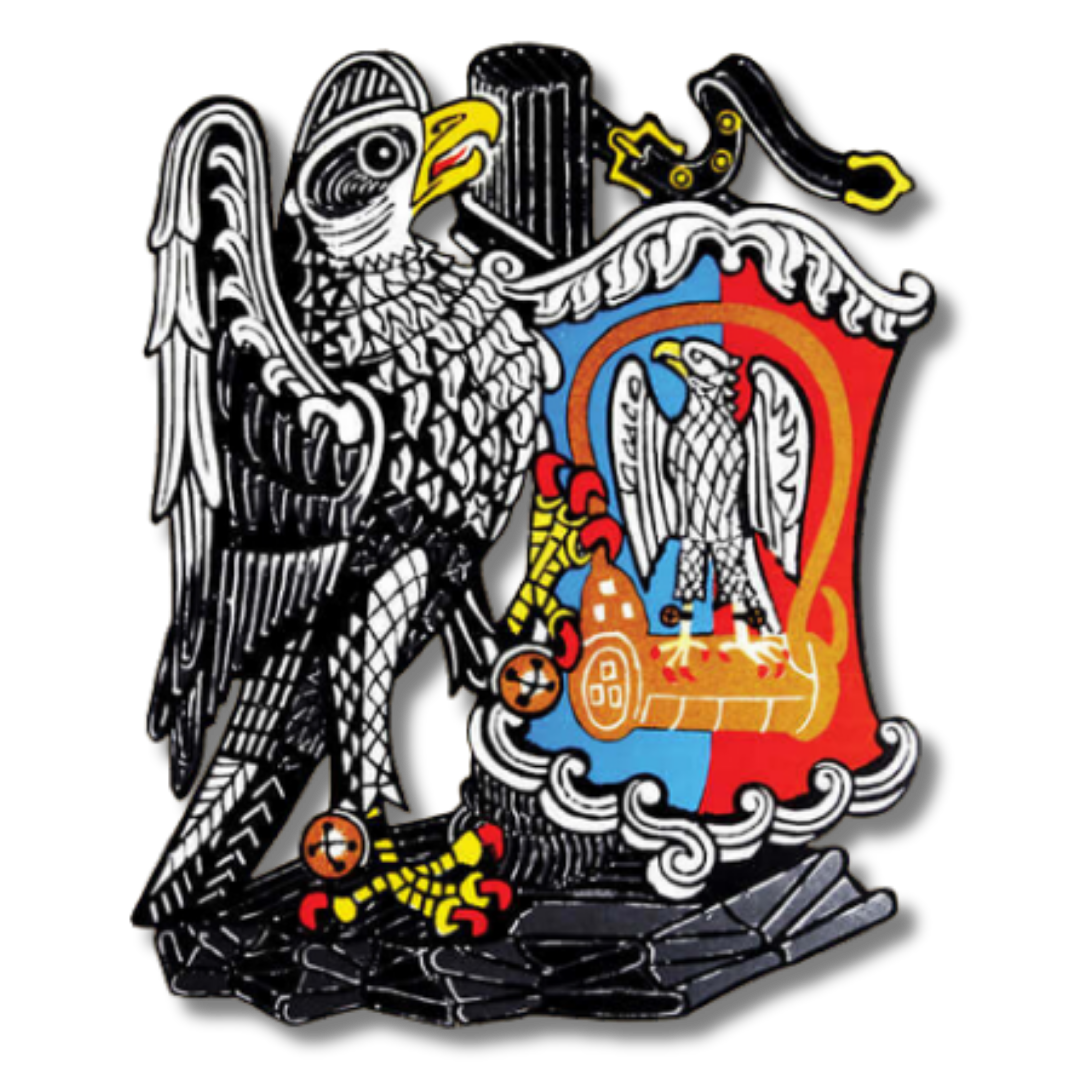
The Falcon was first used as a personal badge by Edward III, passing through the Plantagenet line to Edward IV, who made it particularly his own. The falcon stands within a fetterlock, and where the lock had traditionally been shown closed, Edward depicted it slightly open — a deliberate allusion to the struggle by which he wrested the throne from the House of Lancaster. As the old saying attached to the badge has it: he forced the lock and won the throne.